Where to Park Cash: SGOV and HYSA Fundamentals
Investors constantly seek the optimal vehicle for uninvested capital. In the 2026 interest rate landscape, the debate primarily centers on two highly secure options: The iShares 0-3 Month Treasury Bond ETF (ticker symbol SGOV) and traditional High Yield Savings Accounts (HYSA). Both provide safety, but the underlying financial mechanics differ drastically.
SGOV invests exclusively in ultra-short-term United States Treasury bills. The fund charges a minimal gross expense ratio of 0.09 percent (currently reduced to a net 0.07 percent through active fee waivers) and pays out dividends monthly. The yield closely tracks the Federal Funds rate. On the other hand, major bank HYSAs offer competitive annual percentage yields backed by FDIC insurance up to $250,000 per depositor. While both currently yield returns in the mid-four percent range, the advertised rates only tell half the story.
The Tax Shield Advantage and Liquidity Factors
The most crucial distinction between a Treasury ETF and a standard savings account is the tax treatment. Interest generated from an HYSA is treated as ordinary income and is fully subject to both federal and state taxes. SGOV dividends are generated from government obligations. Therefore, this income is exempt from state and local taxes in nearly all jurisdictions.
Liquidity also presents a clear dividing line, though with important caveats. A high yield savings account provides near-absolute liquidity. Cash can often be transferred instantly at any time of day, including weekends, provided the transfer is between accounts at the exact same institution. However, transferring funds to an external bank via ACH can still take one to three business days.
SGOV, conversely, trades like a stock on the open exchange. Selling shares requires market hours, and under current rules, the cash takes one business day to settle (T+1) and become fully available for withdrawal. Additionally, because SGOV trades on an exchange, its share price exhibits a "sawtooth" pattern—slowly rising throughout the month as interest accrues, then dropping by the dividend amount on the ex-dividend date. Depending on the exact day you sell, this can result in microscopic capital gains or losses.
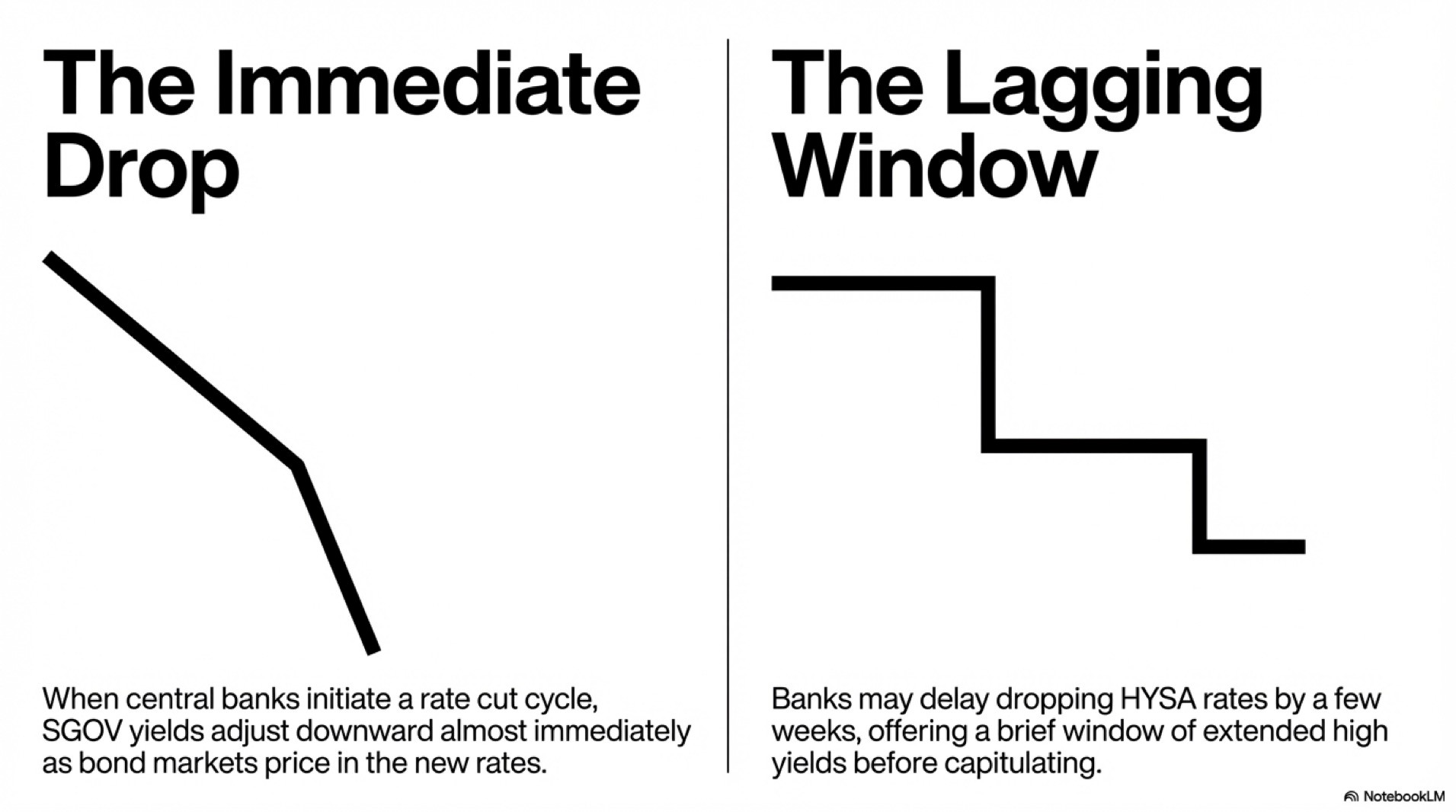
Lastly, when central banks initiate a rate cut cycle, SGOV yields adjust downward almost immediately as bond markets price in the new rates. Banks may delay dropping HYSA rates by a few weeks, offering a brief window of extended high yields.
Simulating the Real After-Tax Return
To understand the true financial impact, running the numbers through a realistic tax scenario is essential. Assume a $100,000 cash balance in a state with an 8 percent income tax, such as California or New York, falling into a 24 percent federal tax bracket.
If both SGOV (net of fees) and the HYSA offer a flat 4.5 percent annual yield, the gross income equals $4,500.
For the HYSA: The total tax burden is 32 percent (federal plus state). The total tax owed is $1,440, leaving a net after-tax return of $3,060.
For SGOV: The state tax is entirely waived. The tax burden is only the 24 percent federal rate. The tax owed is $1,080, resulting in a net return of $3,420.
Parking funds in SGOV yields an additional $360 annually without taking on any additional credit risk. For individuals in high tax brackets residing in states with heavy income taxes, SGOV mathematically outperforms. Conversely, for emergency funds requiring immediate, guaranteed access without market hours constraints, or for individuals in states with zero income tax, the simplicity of an HYSA often wins out.
Disclaimer: Financial data is for educational purposes. Always consult a certified tax professional or financial advisor before making wealth management decisions.