The HBM4 Tipping Point | Hybrid Bonding and the $15B Advanced Packaging CapEx Cycle
The global advanced packaging equipment market is projected to approach $15 billion in 2026 as HBM4 mass production mandates a critical industry shift toward copper-to-copper hybrid bonding and next-generation thermal management solutions.
7
min read
7
min read
By May 2026, earnings calls and technological roadmaps from major memory manufacturers and foundries have solidified the launch timeline for 6th-generation High Bandwidth Memory (HBM4). To overcome the mounting physical and economic limits of front-end node shrinkage, semiconductor giants are redirecting massive capital expenditures toward heterogeneous integration. This massive capital rotation has ignited a structural supercycle across the advanced packaging supply chain.
The Factual Baseline of Capital Reallocation
Investment metrics from the first half of 2026 confirm a permanent shift in how processing power is scaled. Capital allocation strategies have distinctly pivoted away from pure transistor miniaturization.
Market Indicator
2026 Reality
CapEx Growth Rates
Capital expenditure dedicated to expanding advanced packaging facilities is growing at more than twice the rate of traditional front-end foundry investments.
Shipment Records
Data from Semiconductor Equipment and Materials International (SEMI) highlights that global shipment volumes for 2.5D/3D packaging and chiplet assembly hardware are continuously breaking historical records.
Market Expansion
Driven by these factors, the global advanced packaging equipment sector is poised to approach $15 billion this year, maintaining robust double-digit year-over-year expansion.
Upstream: The Copper-to-Copper Bonding Mandate
Mass production of HBM4 requires stacking 16 layers of DRAM, recognized as 16-Hi configurations. At this extreme vertical density, traditional flip-chip and micro-bump technologies reach their physical and electrical limits. The industry is actively replacing these legacy methods with copper-to-copper (Cu-Cu) direct bonding.
The hybrid bonding equipment market is characterized by a strict oligopoly. A select few engineering firms, based primarily in the Netherlands and Japan, hold the core intellectual property required for precision wafer-to-wafer (W2W) and die-to-wafer (D2W) bonding. Industry leaders like Besi (BE Semiconductor Industries) and Tokyo Electron (TEL) control this concentrated supply dynamic, granting these equipment manufacturers immense leverage over global foundries.
Midstream: Glass Substrates and Heat Dissipation
As packaging substrates grow larger to accommodate more complex chiplets and higher I/O pin counts, manufacturers face severe challenges regarding substrate warpage and signal loss. To preserve structural integrity and electrical performance, the integration of glass substrates featuring Through-Glass Vias (TGV) is accelerating rapidly. This shift is drawing significant institutional capital into specialized etching and plating material suppliers.
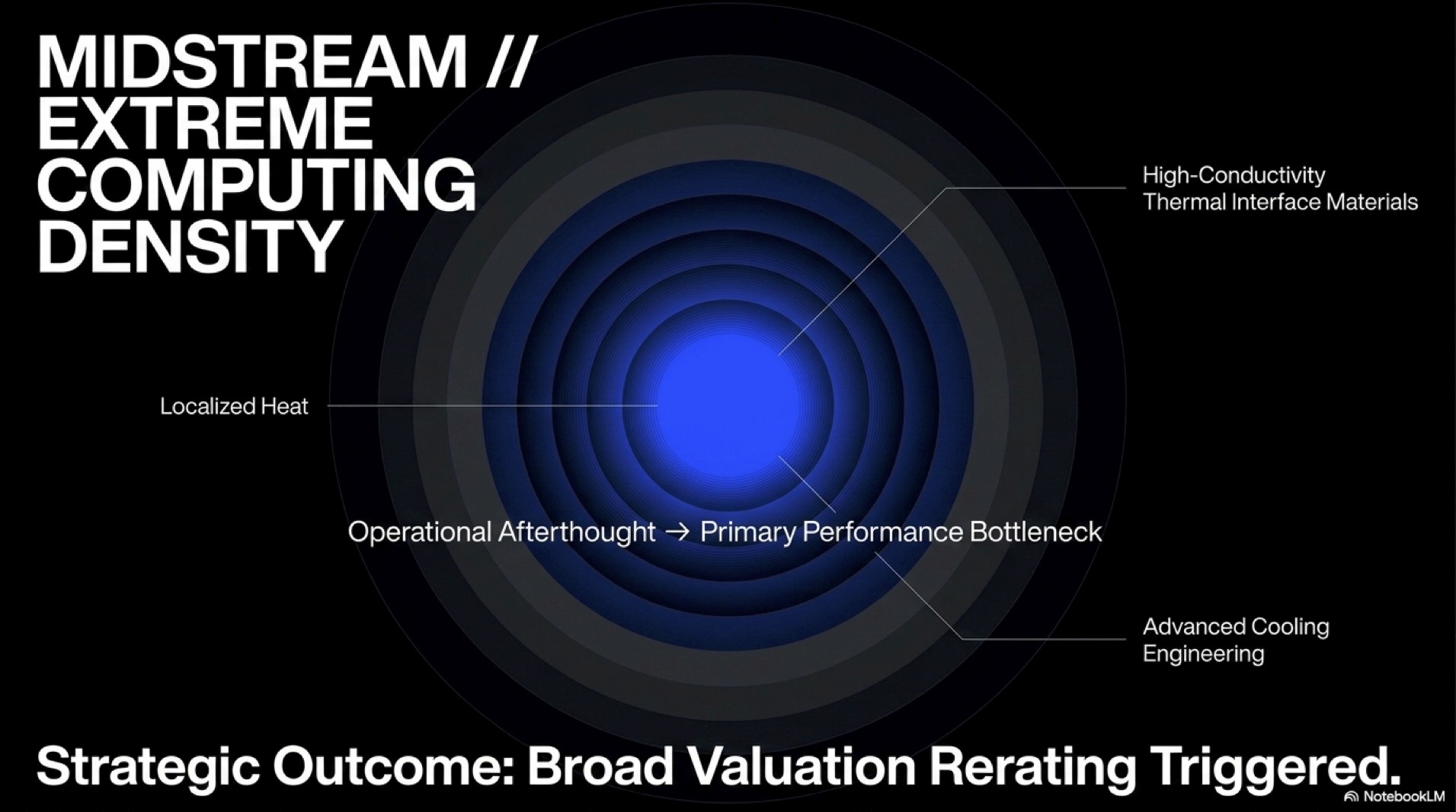
Simultaneously, extreme computing densities generate unprecedented localized heat. Effective AI memory thermal management has transitioned from an operational afterthought to a primary performance bottleneck. This technical hurdle triggers a broad valuation rerating for companies engineering advanced cooling solutions and high-conductivity thermal interface materials.
Downstream: The Zero-Tolerance Metrology Paradigm
Yield management within advanced packaging operates as a high-stakes environment. A single defect during the final 3D integration stage forces the scrapping of both the highly expensive AI GPU and its attached HBM stacks. Because the cost of failure is catastrophic, semiconductor manufacturers aggressively expand their metrology budgets. Procurement orders for non-destructive 3D X-ray inspection systems and ultra-precision optical measurement tools from vendors like Onto Innovation and KLA Corporation are experiencing exponential growth to ensure absolute structural perfection before final deployment.
Sector Insights and Value Migration
The traditional reliance on Moore's Law has ended. The fundamental engine of value creation within the semiconductor industry has migrated from front-end node shrinkage directly into packaging architecture innovation. The critical hardware vendors monopolizing thermal compression (TC) bonders and hybrid bonding platforms now command greater pricing power than their mega-foundry clients. By controlling the exact chokepoints of high-performance computing, these equipment providers have cemented themselves as the premier structural growth assets of the current macroeconomic cycle.
Disclaimer: This content is for informational and reference purposes only. Always conduct independent research before making financial decisions.