The Sovereign AI Boom | National Security CapEx and the $100 Billion GPU Cloud Ecosystem
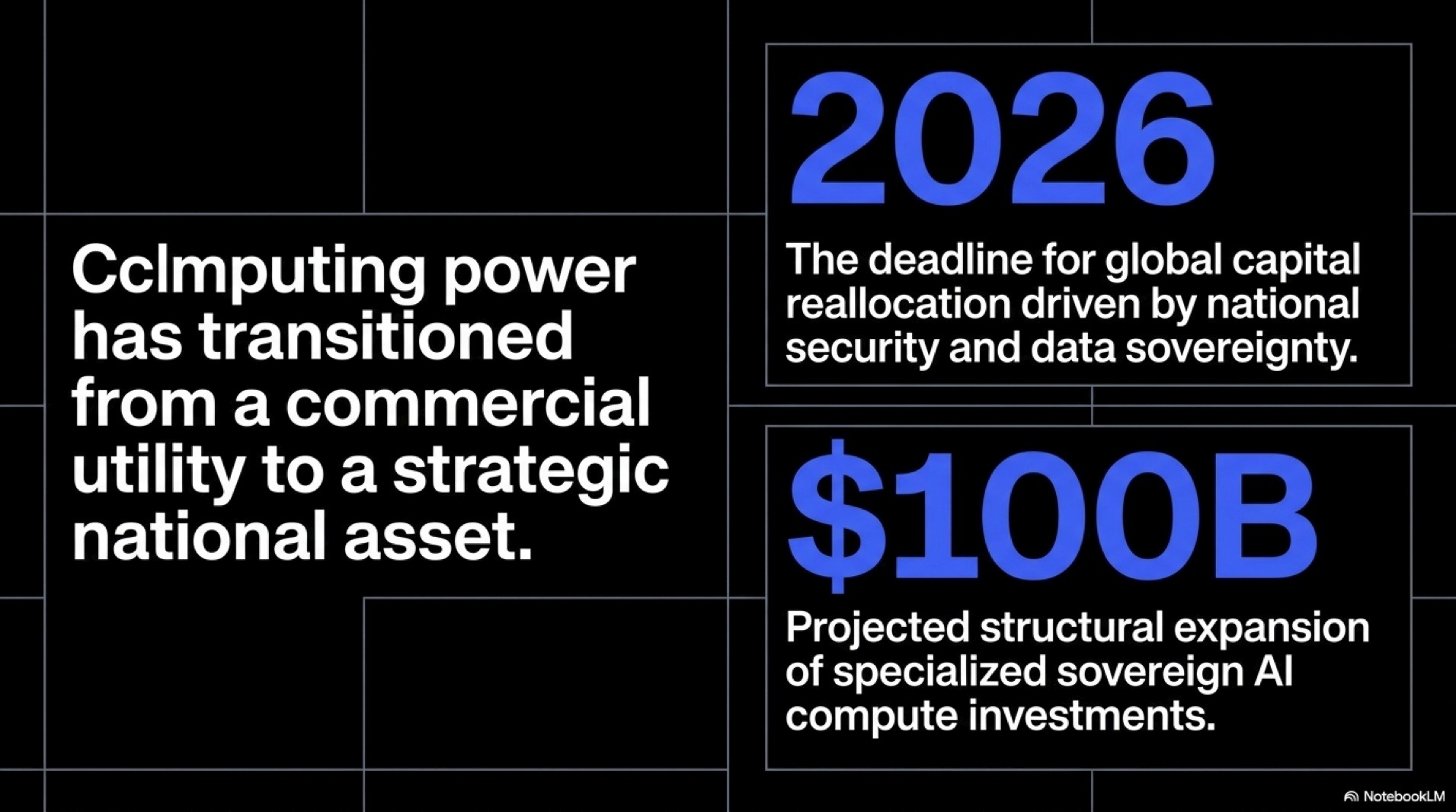
The global acceleration of data localization mandates has elevated sovereign computing infrastructure to a critical national security asset, driving an estimated $100 billion in specialized AI compute investments by 2026.
7
min read
7
min read
By the first half of 2026, the global technology landscape is experiencing a massive capital reallocation driven by national security and data sovereignty mandates. Governments across the Middle East, Europe, and the Asia Pacific no longer rely solely on commercial hyperscalers. Computing power is now recognized as a strategic national asset. This paradigm shift has catalyzed a structural expansion, with specialized sovereign AI compute investments projected to reach approximately $100 billion in 2026. Sovereign wealth funds and state-backed entities are aggressively deploying capital to construct independent, large-scale computing clusters. To comply with strict data localization frameworks, global silicon leaders are increasingly forming Joint Ventures (JVs) with regional telecommunications and IT infrastructure operators.
The Escalation of National Compute Budgets
The financial scale of this transition rivals traditional defense spending. Cumulative budgets allocated for specialized sovereign AI infrastructure by advanced economies eclipse early forecasts, driven by massive national initiatives across regions like South Korea and the Gulf States. This influx of public capital fundamentally alters hardware revenue streams for semiconductor providers.
Market Catalyst
2026 Reality
Regulatory Pressure
The EU AI Act and strict data localization rules enforce independent, sovereign cloud infrastructure deployments.
Hardware Sales
Direct-to-government revenue for primary silicon architects, notably NVIDIA and AMD, expands rapidly.
Capital Source
Sovereign wealth funds and state-backed initiatives replace traditional venture capital in financing hyper-scale GPU clusters.
Upstream: Data Localization and Physical Infrastructure
Stringent regulations now require that AI model training and inference occur entirely within the borders of the data-generating nation. This absolute requirement for data localization significantly inflates the value of regional physical infrastructure. Domestic data center Real Estate Investment Trusts (REITs) and local power grid operators capture massive valuation upside, as national Blackwell B200 or H200 GPU clusters demand immense, geographically confined electrical loads routinely exceeding 100 megawatts (MW) per facility.
Midstream: Air-Gapped Networks and Security Architecture
To leverage advanced intelligence capabilities without compromising state secrets, governments demand highly secure operational environments. This necessity establishes air-gapped data sovereignty cloud architectures as mandatory components of national IT frameworks. Cybersecurity software engineered to protect citizen data while enabling high-performance compute capabilities sees unprecedented institutional demand. The midstream ecosystem heavily relies on hybrid partnerships, blending hyperscaler innovation with impenetrable, state-controlled security layers.
Downstream: The Rise of Local Foundation Models
Reliance on general-purpose, English-centric generative models is fading at the state level. The downstream effect of the sovereign AI movement is the rapid commercialization of a localized foundation model ecosystem. These specialized Large Language Models (LLMs), such as France's production-scale Albert assistant, are meticulously trained on region-specific cultural data, legal frameworks, and localized industrial knowledge, offering unparalleled utility for domestic governance and public sector applications.
The acceleration of sovereign AI infrastructure fundamentally signals the geographic fragmentation of the global technology ecosystem. As computational power becomes the definitive geopolitical standard, the primary financial beneficiaries are insulated from international trade friction. Regional IT service providers, domestic telecommunications firms, and vendors supplying on-premise data management and high-grade cybersecurity solutions stand out as structural winners. These entities provide the foundational architecture for independent national clouds, capturing immense value in a fractured global digital economy.
Disclaimer: This content is for informational and reference purposes only. Always conduct independent research before making financial decisions.