Profiting from Supply Chain Fragmentation | Nearshoring and the Rise of Autonomous Warehouse Real Estate
The geographic realignment of global supply chains has accelerated nearshoring investments, stabilizing North American industrial vacancy rates at 7.0% while propelling the autonomous warehouse robotics market to an estimated $8.8 billion in 2026.
7
min read
7
min read
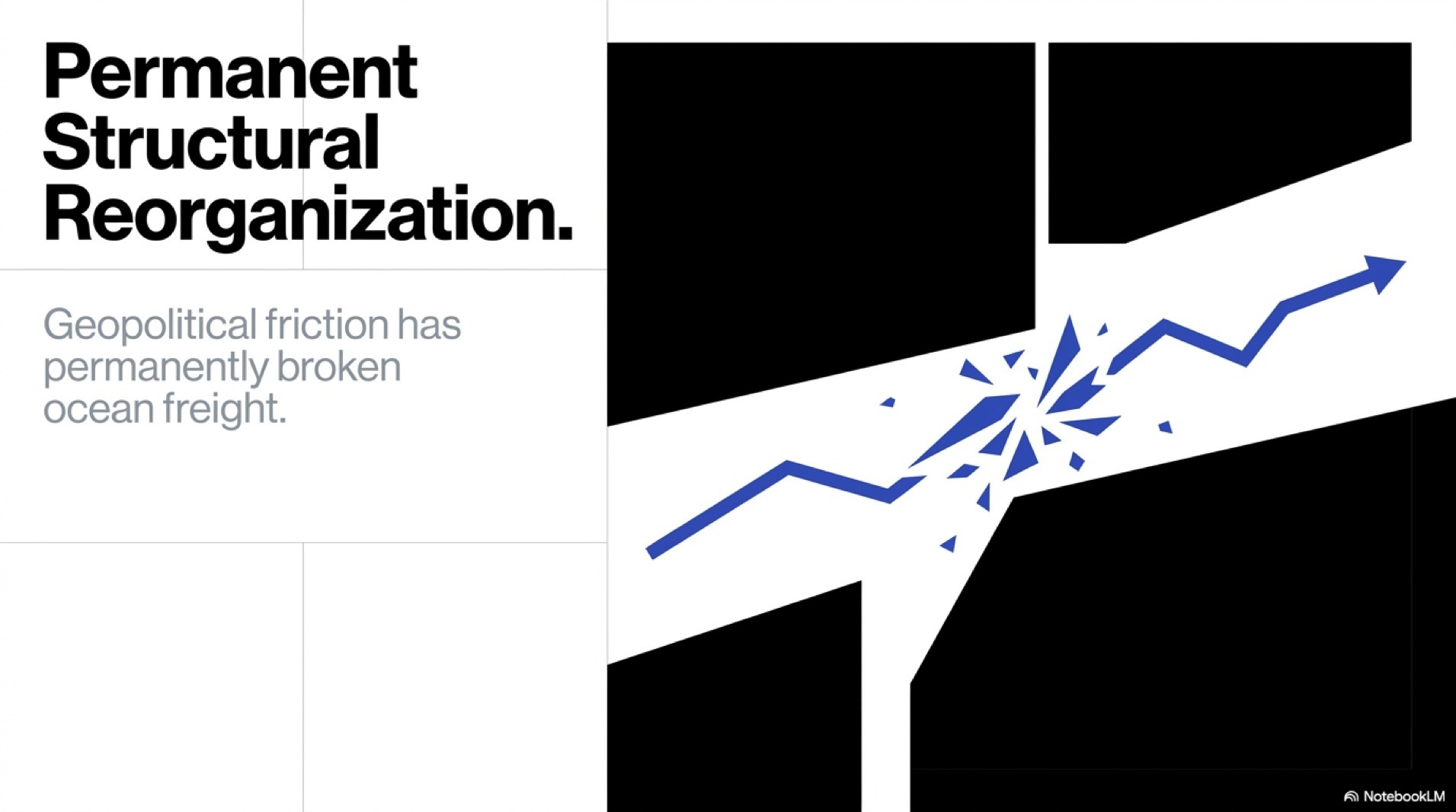
Geopolitical friction and chronic maritime route volatility have permanently disrupted critical shipping chokepoints, embedding structural risk into major ocean freight indices. Consequently, global supply chains are undergoing a massive geographic realignment. Foreign Direct Investment (FDI) data confirms an accelerated migration of capital out of traditional Asian manufacturing hubs directly into consumer-adjacent nations. This localization strategy fundamentally restructures the 2026 North American supply chain framework, pushing inland overland transport and intermodal freight volume growth rates past traditional maritime import expansion.
The Economics of De-Globalization
The collapse of traditional offshoring models exposes manufacturers to intense wage inflation within developed and nearshored economies. To neutralize these rising labor costs, corporations are executing aggressive operational strategies centered on route compression and massive technological deployment.
Capital expenditure on micro-fulfillment operations and autonomous warehouse robotics is projected to reach approximately $8.8 billion in 2026, correcting previous overestimates of a $30 billion market. Companies are strategically substituting cheap overseas labor with high upfront industrial real estate investments. By deploying automated fleets equipped with computer vision and machine learning, operators stabilize unit economics despite the higher baseline costs of localized manufacturing.
Infrastructure Bottlenecks in Emerging Hubs
The rapid influx of manufacturing capacity into prime nearshoring regions, specifically Northern Mexico and Eastern Europe, has triggered secondary logistical bottlenecks.
Power Grids: Insufficient high-voltage electrical capacity to sustain new, highly concentrated industrial zones.
Water Resources: Municipal supply constraints threatening heavy manufacturing output.
Port and Rail Terminals: Cargo handling limitations capping import and export velocities.
These localized utility deficits have inadvertently generated a significant value appreciation cycle for regional utility providers and heavy civil engineering firms tasked with upgrading the host nations.
The Real Estate Valuation Shift
The definition of a highly valued logistics asset has completely transformed. Standard, first-generation storage warehouses no longer command premium valuations. Institutional capital is prioritizing highly specialized nearshoring logistics infrastructure.
Modern industrial Real Estate Investment Trusts (REITs), such as Prologis, must now equip facilities with ultra-fast 5G communication networks and heavy-duty high-voltage grids capable of charging fleets of Automated Guided Vehicles (AGVs) and Autonomous Mobile Robots (AMRs). While the broader U.S. national industrial vacancy rate has stabilized near 7.0% in early 2026, prime nearshoring facilities meeting these advanced specifications across the US Sunbelt and Northern Mexico submarkets like Monterrey maintain significantly tighter availability, sustaining a localized rent growth rally.
Infrastructure Paradigm
Traditional Offshoring
Smart Nearshoring (2026)
Primary Focus
Deep-water port access
Consumer proximity & Intermodal connectivity
Labor Model
High-volume, low-cost human labor
Autonomous warehouse robotics (AGVs/AMRs)
Facility Specs
Basic high-bay storage capacity
5G, high-voltage AGV charging grids
Capital Allocation
Weighted toward maritime shipping
Weighted toward software and physical real estate
Macro Insight: De-Risking the Supply Chain
Geopolitical conflicts disrupting global trade represent a permanent structural reorganization rather than a temporary anomaly. Entities controlling physical smart warehousing assets near end-consumers, alongside the technology vendors developing unmanned sorting and control software like Symbotic, provide the most robust defense in the current macroeconomic de-risking cycle. Securing intelligent logistics real estate has become an operational necessity for modern commercial survival.
Disclaimer: This content is for informational and reference purposes only. Always conduct independent research before making financial decisions.