The Algorithm of War | AI Swarm Drones and the Restructuring of the Global Defense Budget
In 2026, global procurement budgets for autonomous defense systems and related AI control networks surged to an estimated $75 billion, permanently shifting military capital expenditure away from legacy manned platforms toward decentralized drone swarms and high-margin Counter-UAS infrastructure.
7
min read
7
min read
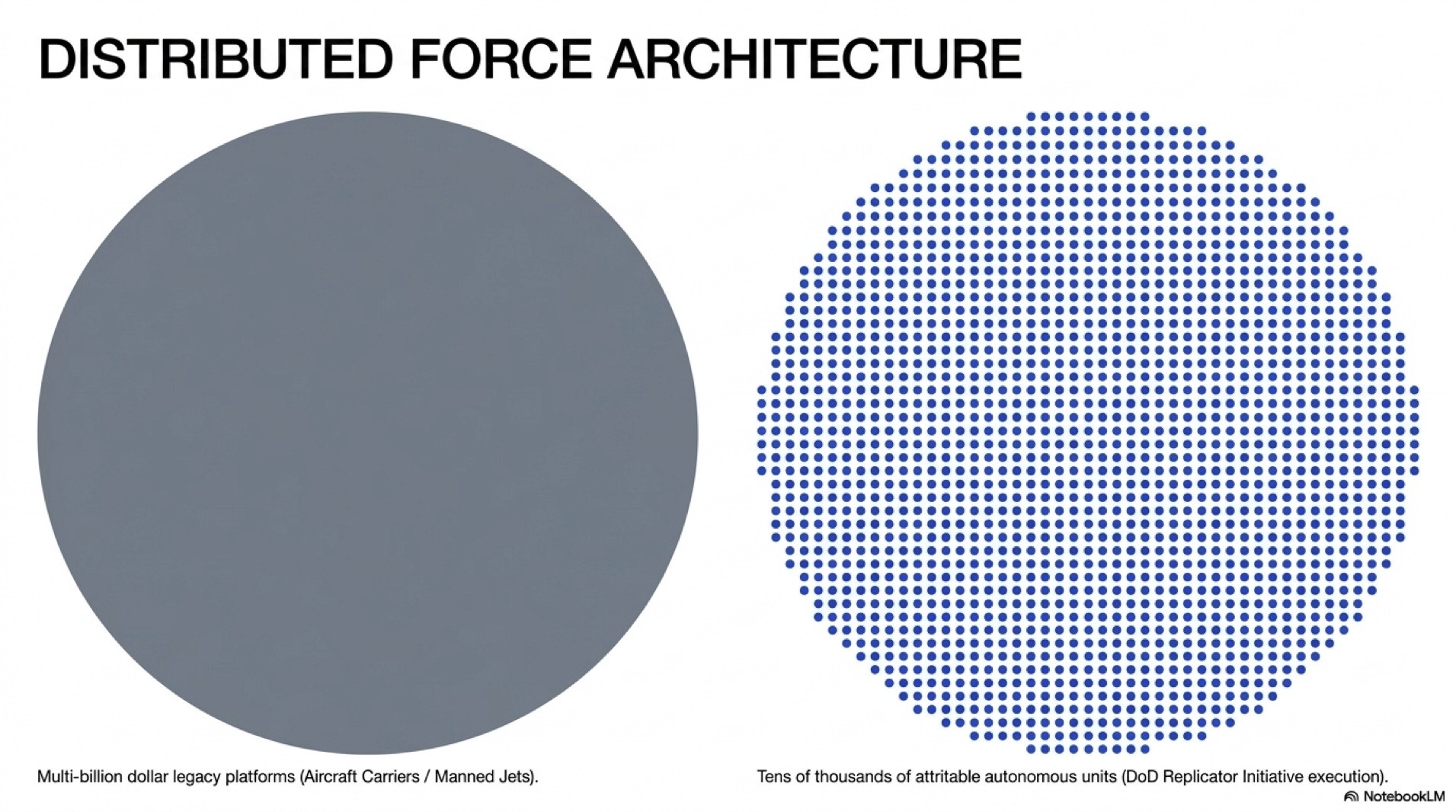
Recent geopolitical friction across Eastern Europe and the Middle East provides undeniable proof of concept for artificial intelligence in modern combat. The successful deployment of autonomous UAVs to neutralize traditional air defense networks triggers an immediate and aggressive reallocation of sovereign military spending. Global governments are decisively pivoting defense tech CapEx away from concentrated, multi-billion dollar legacy platforms like aircraft carriers and manned fighter jets. Capital now flows directly into distributed force architectures characterized by thousands of low-cost, attritable unmanned aerial vehicles powered by advanced machine learning models.
The Catalyst for Capital Reallocation
The fundamental economics of warfare are undergoing a rapid transformation. Symmetrical warfare now demands numerical superiority achieved through scalable technology rather than purely kinetic firepower. This reality catalyzes unprecedented financial movements between traditional defense prime contractors and Silicon Valley deep-tech startups, resulting in a record volume of joint ventures and exclusive software licensing agreements with firms such as Palantir Technologies and Anduril Industries.
Market Indicator
2026 Financial Reality
Budget Expansion
Global spending on autonomous defense systems and related AI control networks reaches an estimated $75 billion.
DoD 'Replicator'
Official 2026 budget execution confirms the active deployment of tens of thousands of autonomous units via the Pentagon's Replicator Initiative.
Investment Influx
Institutional capital heavily weights toward directed energy weapons and advanced Counter-UAS (c-UAS) market solutions.
Supply Chain Disruption and Value Migration
The rapid adoption of AI drone swarms fundamentally restructures the aerospace and defense supply chain, moving profit margins away from physical manufacturing and toward advanced computing and sensor technologies.
The Commoditization of Hardware
Basic airframe manufacturing is rapidly commoditizing. The utilization of 3D printing and Commercial Off-The-Shelf (COTS) components drastically reduces the unit cost of physical drones. Consequently, hardware value migrates toward highly specialized components necessary for electronic warfare survival, specifically quantum sensors and advanced optical arrays capable of maintaining navigation in heavily jammed environments where standard GPS/GNSS signals are degraded.
Edge Computing as the New Munition
The operational success of a swarm dictates that thousands of individual units must communicate, avoid collisions, and acquire targets without centralized human intervention. On-device neural network control chips and sophisticated edge computing architectures are now the most critical components of the modern arsenal. The algorithmic brain of the UAV, championed by proprietary systems like Shield AI's Hivemind software, commands a significantly higher financial premium than the physical fuselage.
The Counter-UAS Economic Imperative
The proliferation of offensive swarms necessitates an equally scalable defensive posture. Traditional kinetic interceptor missiles, which often cost millions of dollars per launch, are economically unviable against a swarm of inexpensive drones. This asymmetrical cost curve triggers massive spending within the Counter-UAS market. Procurement heavily favors High-Power Microwave (HPM) systems, such as the Epirus Leonidas, alongside high-energy laser weapons that offer an operational cost-per-kill of less than one dollar.
Macro Insights: The Algorithmic Battlefield
The core metric of modern defense dominance has transitioned from raw kinetic firepower to data processing velocity and algorithmic targeting capabilities. Legacy defense contractors relying solely on heavy manufacturing face severe structural headwinds. The definitive beneficiaries of this revised defense spending pipeline are the B2B technology vendors monopolizing edge AI computing hardware, military-grade cybersecurity firmware, and resilient mesh network communications. These critical tech providers hold the keys to the next decade of defense modernization.
Disclaimer: This content is for informational and reference purposes only. Always conduct independent research before making financial decisions.