CRWD vs PANW | Evaluating Cybersecurity Market Share and Earnings Growth in 2026 The Core Financial Metrics
When evaluating cybersecurity stocks 2026, Palo Alto Networks provides superior financial resilience through vendor consolidation and deferred billing strategies, whereas CrowdStrike maintains the edge in rapid revenue growth while expanding beyond its traditional endpoint dominance.
6
min read
6
min read
Enterprise security market share is rapidly shifting as organizations finalize their IT budgets for 2026. The competition between CrowdStrike (CRWD) and Palo Alto Networks (PANW) represents a broader battle between pure-play specialization and comprehensive platform consolidation. Analyzing recent quarterly earnings calls and SEC filings provides a clear picture of their financial health.
Financial Metric (2026 Baseline Estimates)
CrowdStrike (CRWD)
Palo Alto Networks (PANW)
Annual Recurring Revenue (ARR)
$4.8 Billion
$5.2 Billion (NGS ARR)
Gross Margin
78 Percent
75 Percent
Free Cash Flow (FCF) Margin
33 Percent
39 Percent
Net Retention Rate (NRR)
Approx. 119 Percent
Approx. 115 Percent
The data highlights two highly profitable operations. CrowdStrike operates with a slight advantage in gross margins due to a cloud-native, software-only deployment model. Conversely, Palo Alto Networks commands a higher Free Cash Flow margin, showcasing immense operational efficiency at a massive scale.
Business Model Divergence and Retention Rates
The underlying difference in enterprise security market share growth stems from fundamentally different architectural philosophies.
CrowdStrike built a dominant reputation in endpoint security. The Falcon platform remains the gold standard for stopping breaches at the device level. While rooted in endpoint dominance, CrowdStrike is rapidly expanding its Falcon platform into cloud security, identity threat protection, and next-generation SIEM to counter broader industry consolidation plays. This intense product execution translates into an incredibly sticky ecosystem, reflected in an exceptionally high Net Retention Rate. Once integrated into a corporate network, replacing CrowdStrike becomes a costly and complex logistical challenge.
Palo Alto Networks approaches the market through aggressive platformization. Rather than focusing solely on endpoints, the strategy involves securing the entire network architecture. By bundling firewalls, cloud security, and Security Operations Center tools, the company effectively forces legacy competitors out of the budget. Implementing a holistic zero-trust architecture is often cheaper for enterprise clients when sourced from a single vendor like Palo Alto Networks, rather than cobbling together multiple specialized services.
Insights for the Enterprise Consolidation Trend
A CRWD vs PANW comparison ultimately comes down to understanding corporate spending behaviors. Chief Information Security Officers face immense pressure to reduce software bloat and optimize vendor relationships.
In an environment where large enterprises actively look to cut down the number of software contracts managed, Palo Alto Networks holds a distinct structural advantage. The ability to offer deferred billing—allowing clients to use PANW products for free until their legacy competitor contracts expire—alongside deep discounts on bundled services protects enterprise security market share and guarantees long-term contract renewals. The 39 percent FCF margin provides the necessary capital to sustain this aggressive pricing strategy without damaging overall profitability.
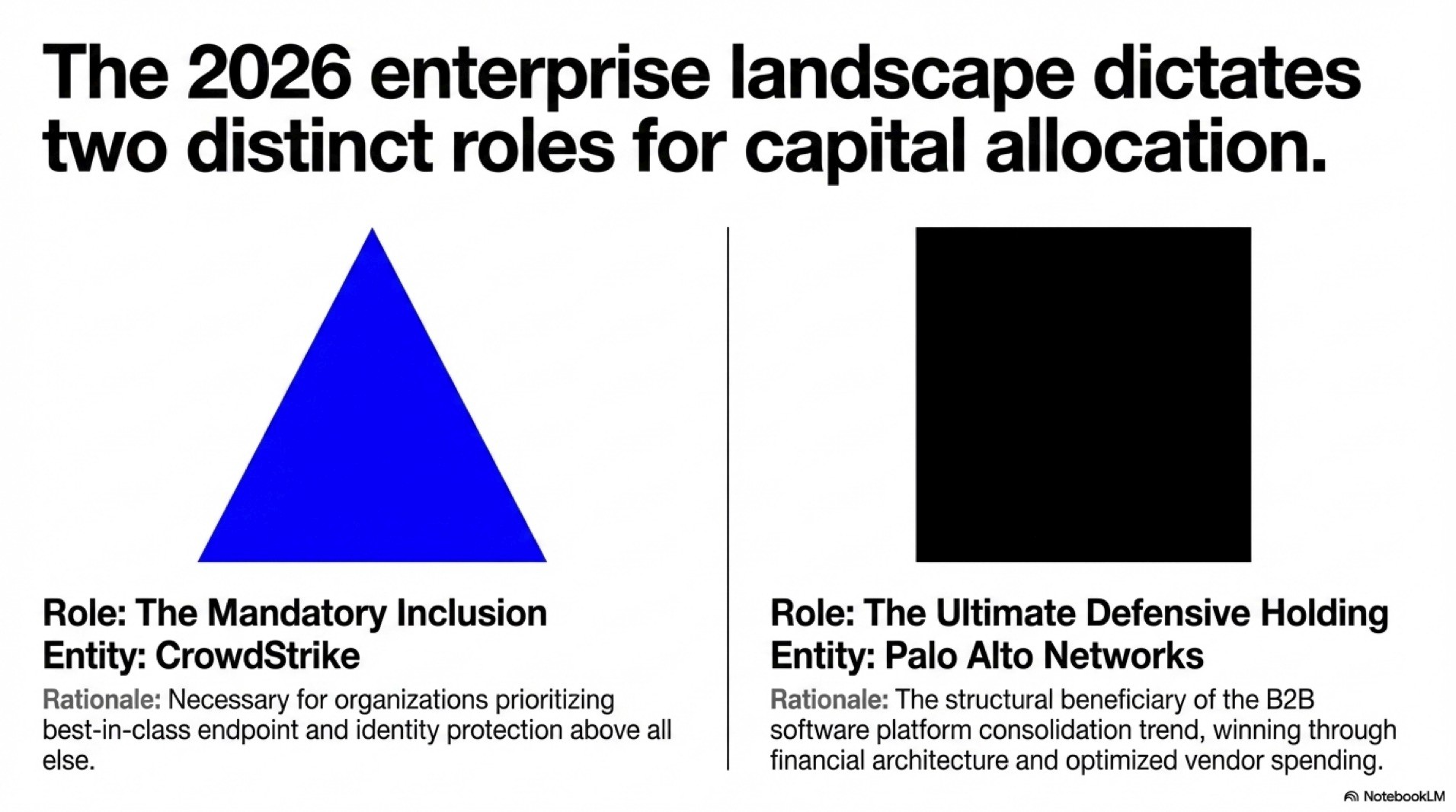
CrowdStrike remains a mandatory inclusion for organizations prioritizing best-in-class endpoint and identity protection above all else. However, for investors tracking cybersecurity stocks 2026, the broader platform consolidation trend heavily favors the financial architecture of Palo Alto Networks as the ultimate defensive holding in the B2B software sector.
Disclaimer: Financial data and projections are based on public SEC filings and industry consensus. This analysis is for informational purposes only and does not constitute financial advice. Conduct thorough research before making investment decisions.