When analyzing semiconductor market trends, the broader financial conversation heavily revolves around general-purpose graphics processing units. However, as artificial intelligence data centers scale into gigawatt territories in 2026, a new critical bottleneck has emerged. The investment focus is rapidly shifting toward AI networking infrastructure and Application-Specific Integrated Circuits, commonly known as ASICs. Evaluating AVGO vs AMD stock requires looking past the immediate GPU hype and understanding who controls the complex web of data transfer and custom chip design.
Baseline Metrics: AI Revenue and Free Cash Flow
To assess the structural advantages of both companies, we must examine their underlying financial mechanics and their grip on the custom silicon pipeline. The 2026 landscape highlights two very different margin profiles.
Broadcom (AVGO)
AI Revenue Growth: Driven heavily by custom ASIC contracts and networking switches, AI-related revenue is expanding at an estimated 45 percent year over year.
Custom Silicon Presence: Holds a dominant duopoly leadership position alongside Marvell Technology (MRVL) in designing custom chips for hyperscalers, securing massive multi-year contracts with Meta and Google.
Free Cash Flow Margin: Exceptionally high, consistently operating near the 45 to 50 percent range due to software integration and dominant pricing power in networking.
Advanced Micro Devices (AMD)
AI Revenue Growth: Experiencing aggressive triple-digit growth primarily fueled by the deployment of their MI series data center accelerators.
Custom Silicon Presence: Active in semi-custom designs, but the primary corporate focus remains on capturing general-purpose GPU market share.
Free Cash Flow Margin: Healthy but lower than Broadcom, sitting closer to the 20 to 25 percent range as the company reinvests heavily into closing the hardware gap with its primary GPU competitors.
Strategic Divergence: General Compute vs Custom Networks
The core difference between these two semiconductor giants lies in their relationship with the world's largest technology companies.
AMD is attacking the compute monopoly head-on. Their approach is to offer a highly capable, slightly more cost-effective alternative to the dominant GPUs on the market. This is a massive total addressable market, but it places AMD in direct, fierce competition for general-purpose accelerator budgets.
Broadcom takes a completely different path. Companies like Google and Meta realize that relying entirely on off-the-shelf GPUs is too expensive and power-intensive for their specific, internal AI workloads. They want to design their own custom AI silicon in 2026. However, they lack the specific physical design and packaging expertise to manufacture them at scale. Broadcom serves as the ultimate design partner. Instead of competing with the hyperscalers, Broadcom enables them, effectively securing guaranteed, high-margin revenue streams that are entirely insulated from the traditional GPU pricing wars.
The Networking Bottleneck and Infrastructure Winners
As large language models scale to trillions of parameters, computing power is no longer the sole priority. The new limitation is data transfer. When a hyperscaler connects one hundred thousand chips together to train a single model, the speed at which those chips talk to each other dictates the efficiency of the entire multi-billion-dollar data center.
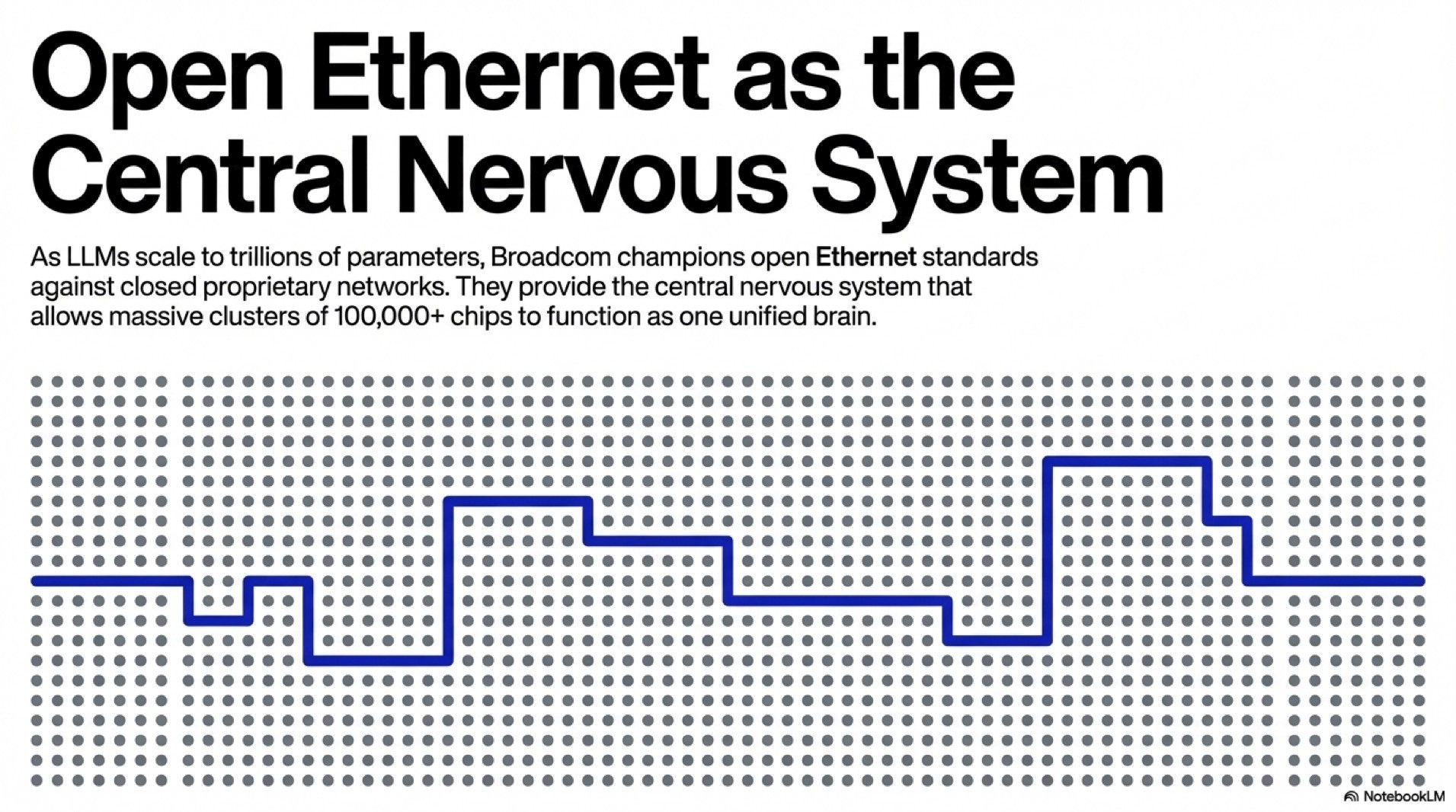
This is where the true value of AI networking infrastructure becomes apparent. If the network experiences even micro-seconds of latency, expensive compute chips sit idle waiting for data. Broadcom dominates this space by championing open Ethernet standards against closed proprietary networks. They provide the central nervous system that allows the AI data center to function as one unified brain. To remain competitive in this arena and defend its data center footprint, AMD has strategically countered by building out its own networking capabilities through the acquisitions of Xilinx and Pensando, offering robust DPU and SmartNIC infrastructure to alleviate these bottlenecks.
While AMD offers an excellent growth opportunity for investors betting on a diversified GPU market, Broadcom represents the hidden structural foundation of the AI revolution. For investors focused on sustainable free cash flow and dominant positioning within the custom silicon and networking sectors, Broadcom currently stands as the most critical infrastructure play of the decade.
Disclaimer: All financial data and corporate projections are based on public consensus estimates for 2026. This article is for informational purposes only and does not constitute personalized financial or investment advice. Always conduct thorough independent research before allocating capital.