The agricultural sector is no longer just about physical labor and basic chemistry. Climate volatility, unpredictable rainfall, and severe global labor shortages have elevated the precision agriculture market from an optional luxury to a mandatory survival tool. Global institutions are closely monitoring food security macro trends, recognizing that technological intervention is the only viable way to maintain global supply chains. For investors analyzing AgTech stocks in 2026, the landscape is currently dominated by two contrasting approaches. A DE vs CTVA analysis reveals whether capital is better allocated toward advanced robotics or essential biological engineering.
Evaluating the Financial Foundation and Global Reach
To understand how these companies capture value within the agricultural ecosystem, it is essential to look at their capital allocation and geographic exposure. The hard data highlights two very different operational scales.
Deere & Company (DE) allocates over 2 billion dollars annually to research and development. The company generates massive free cash flow, frequently exceeding 4 billion dollars during strong commodity cycles. However, its revenue structure remains heavily concentrated in North American markets.
Corteva Agriscience (CTVA) directs roughly 1.3 billion dollars toward its specialized R&D pipeline. While its free cash flow sits lower at approximately 2 billion dollars, its geographic footprint is incredibly diverse. Corteva captures massive market share across Latin America and rapidly expanding emerging markets.
The Software Tractor versus The Resilient Seed
The core business models of these two agricultural titans are moving in completely different directions to solve the exact same global crisis.
Deere is actively executing a strategy to turn heavy hardware into highly profitable software. The company is no longer just selling a physical piece of machinery. Through innovations like fully autonomous driving and its revolutionary "See & Spray" artificial intelligence cameras—which instantly identify and target individual weeds to reduce chemical use—Deere is building a comprehensive digital ecosystem. By shifting toward a subscription-based model for its precision farming software, Deere is attempting to smooth out the traditional cyclical nature of equipment sales and secure high-margin, recurring revenue from its massive existing fleet.
Corteva approaches the yield problem strictly at the molecular level. Their entire business model relies on providing genetically advanced seeds that can withstand extreme weather, alongside proprietary crop protection chemicals. A prime example is their highly successful "Enlist" weed control system, which tightly couples specific hybrid seeds with proprietary herbicides, creating a powerful ecosystem lock-in. This represents a highly defensible biological moat. While a tractor can be repaired and kept running for over a decade, farmers cannot effectively reuse hybrid seeds without sacrificing massive amounts of yield. They are required to buy new seeds and specific chemical treatments every single planting season to remain operational.
Navigating the Commodity Price Cycle
The true economic test for these companies occurs when the global prices of corn and soybeans decline. Understanding farmer psychology during a downcycle provides the ultimate insight into which entity holds true pricing power.
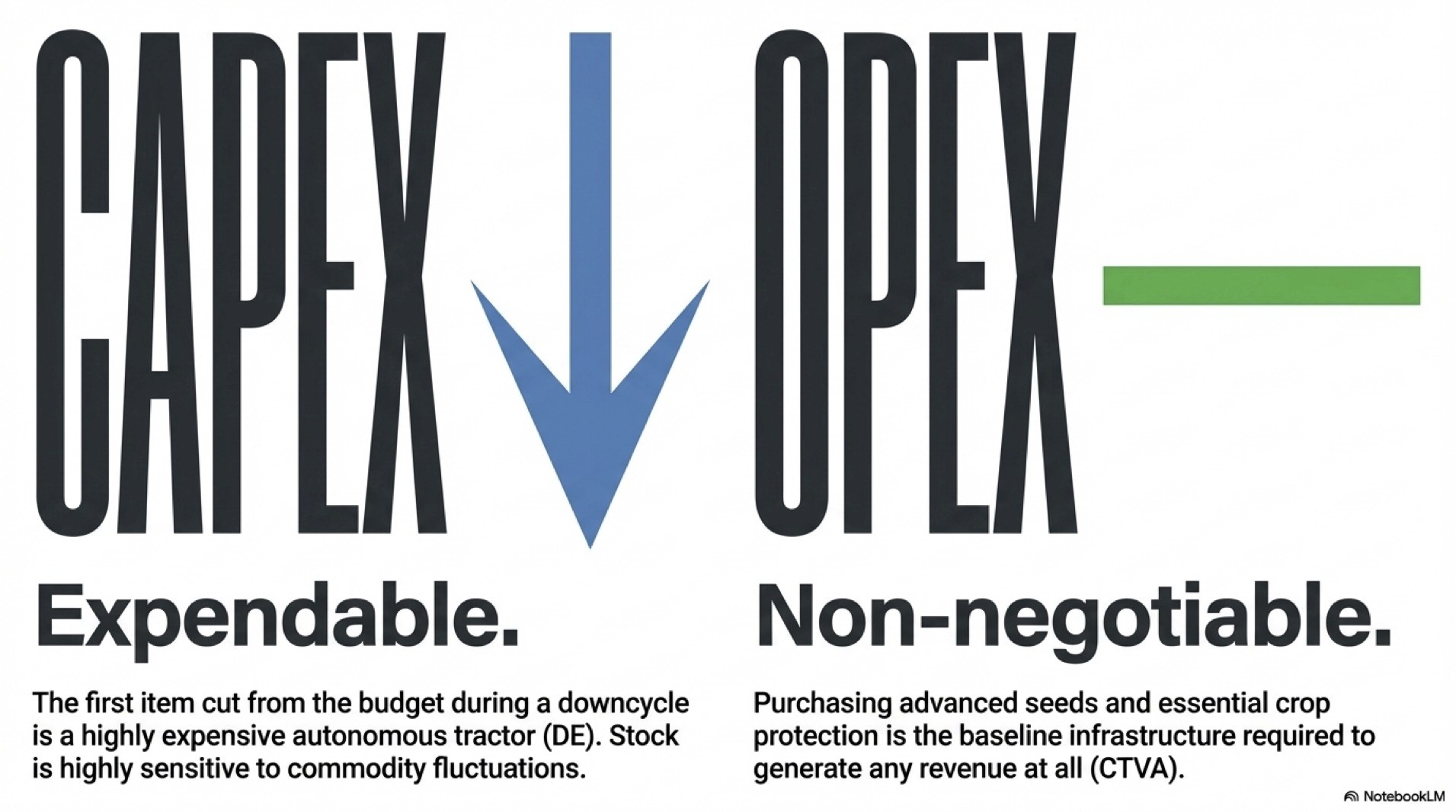
When crop prices fall and net farm income shrinks, agricultural operators immediately look to reduce their capital expenditures (CAPEX). The first item cut from the budget is usually a brand new, highly expensive autonomous tractor. While Deere is rapidly growing its software revenue, its core earnings are still heavily tied to these massive physical equipment purchases, making the stock highly sensitive to commodity price fluctuations.
Conversely, a farmer cannot skip planting. Even in a severe economic downturn, purchasing advanced seeds and essential crop protection from Corteva is completely non-negotiable operational expenditure (OPEX). It is the absolute baseline infrastructure required to generate any revenue at all for the year. Therefore, during periods of depressed grain prices, Corteva offers superior margin protection and reliable cash flow visibility. However, when farm incomes are soaring and cash reserves are high, Deere possesses the technological leverage to capture massive capital upgrades as farmers rush to modernize their physical operations.
Disclaimer: This content is for informational and reference purposes only and does not constitute financial advice. Always conduct independent research before making investment decisions.