Decoding the Payment Network Stocks
Payment networks serve as the ultimate frontline indicators of global economic health. Trillions of dollars flow through these digital architectures every year. For investors analyzing the fintech market trends in 2026, comparing Visa and American Express offers profound insights into consumer spending indicators. These two financial giants operate with completely different profit models, making them perfect barometers for evaluating both broad international consumer health and high-income spending resilience.
The Factual Baseline: Volume and Margins
To evaluate these companies properly, examining their core financial engines is required. The data reveals exactly how their distinct business models translate into revenue.
Visa (Ticker Symbol V)
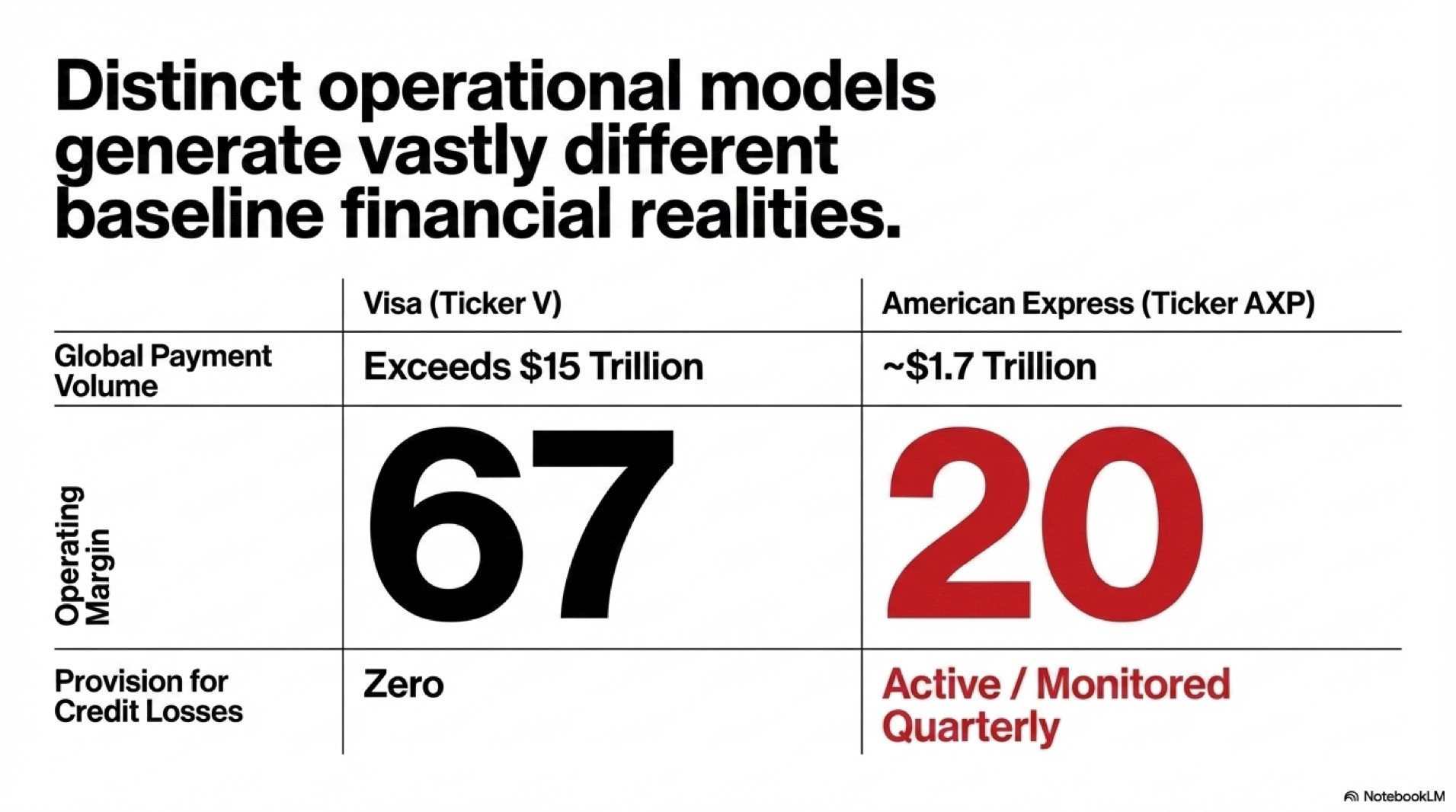
Global Payment Volume: Exceeds 15 Trillion dollars annually.
Operating Margin: Consistently hovering around 67 percent.
Provision for Credit Losses: Zero.
American Express (Ticker Symbol AXP)
Global Payment Volume: Approximately 1.7 Trillion dollars annually.
Operating Margin: Generally near 20 percent.
Provision for Credit Losses: Active and strictly monitored every quarter.
Open Loop Efficiency vs Closed Loop Lending
The massive difference in operating margins and credit loss provisions stems from structural network differences.
Visa operates an open-loop network. While the company functions primarily as a digital toll booth connecting consumers, merchants, and banking institutions, its massive margins are increasingly driven by Value-Added Services (VAS) such as fraud prevention, data security, and consulting. Visa processes the transaction but never actually lends the money. Because there is zero credit risk, the operating margins are extraordinarily high. The company is completely insulated from consumer loan defaults, making it highly resilient during periods of rising interest rates.
American Express operates a closed-loop network. The company processes the transaction and also acts as the bank issuing the credit. This dual role allows American Express to capture merchant fees while also earning significant interest income from cardholders. However, this model introduces direct credit risk. When the global economy tightens, American Express must increase its provision for credit losses to prepare for potential borrower defaults, making the stock far more sensitive to interest rate fluctuations.
Macroeconomic Insights from Global Consumers
Analyzing these two payment networks side by side reveals a fascinating story about current global wealth distribution and consumer confidence.
American Express strategically targets premium, high-income consumers and corporate clients, with a significant demographic shift showing that over 60 percent of new card acquisitions now come from Millennial and Gen Z cohorts. Strong earnings and low default rates from this company indicate that this younger, upper-economic tier remains largely unaffected by inflation or broader market downturns. Wealthy consumers continue to travel and spend globally for premium experiences.
Conversely, Visa captures the massive global middle class across countless international markets. A slowdown in Visa payment volume serves as an early warning system that everyday consumers are feeling the pinch of inflation and reducing discretionary purchases. Therefore, monitoring both companies simultaneously is essential. A scenario where American Express thrives while Visa slows down points to a bifurcated "K-shaped" global economy, where wealth concentration allows premium spending to continue while the broader international middle class tightens its belt.
Disclaimer: Financial data is based on industry consensus estimates for educational purposes. This analysis does not constitute personalized investment advice. Always perform independent research before making financial decisions.