Tokenizing the Real Economy | Institutional RWA Adoption and the Restructuring of Asset Management
The total value of on-chain tokenized real-world assets has surged past $36 billion in 2026, driven by institutional adoption of T+0 blockchain settlement that reduces back-office operational costs by up to 50%.
7
min read
7
min read
The financial architecture of global asset management is undergoing a fundamental rewrite. By the first half of 2026, tier-one asset managers have aggressively expanded their tokenization strategies beyond highly liquid sovereign debt. Institutional capital is now flowing directly into the fractionalization of illiquid alternative investments, including private equity (PE), commercial real estate, and infrastructure funds. Public blockchains are no longer viewed as speculative environments but are being actively deployed as the core backend infrastructure for global financial markets, supported by leading tokenization platforms like Securitize and Ondo Finance.
The Macro Fundamentals of Institutional Tokenization
The momentum behind institutional Decentralized Finance (DeFi) adoption is rooted in measurable operational efficiency and capital velocity. Market data confirms a structural transition as traditional finance integrates with on-chain ecosystems.
Market Reality (2026)
Fundamental Driver
Tokenized MMF Expansion
Continuous upward trajectory in the market capitalization of tokenized money market funds and short-term Treasuries managed by legacy institutions like BlackRock and Franklin Templeton.
Private Credit Surge
On-chain private credit lending volumes have more than doubled year-over-year, utilizing smart contracts for automated collateral management.
Wholesale Settlement
Successful pilot testing by the Bank for International Settlements (BIS) integrating wholesale Central Bank Digital Currencies (wCBDC) directly with tokenized real-world assets.
Ecosystem Analysis: The New Financial Value Chain
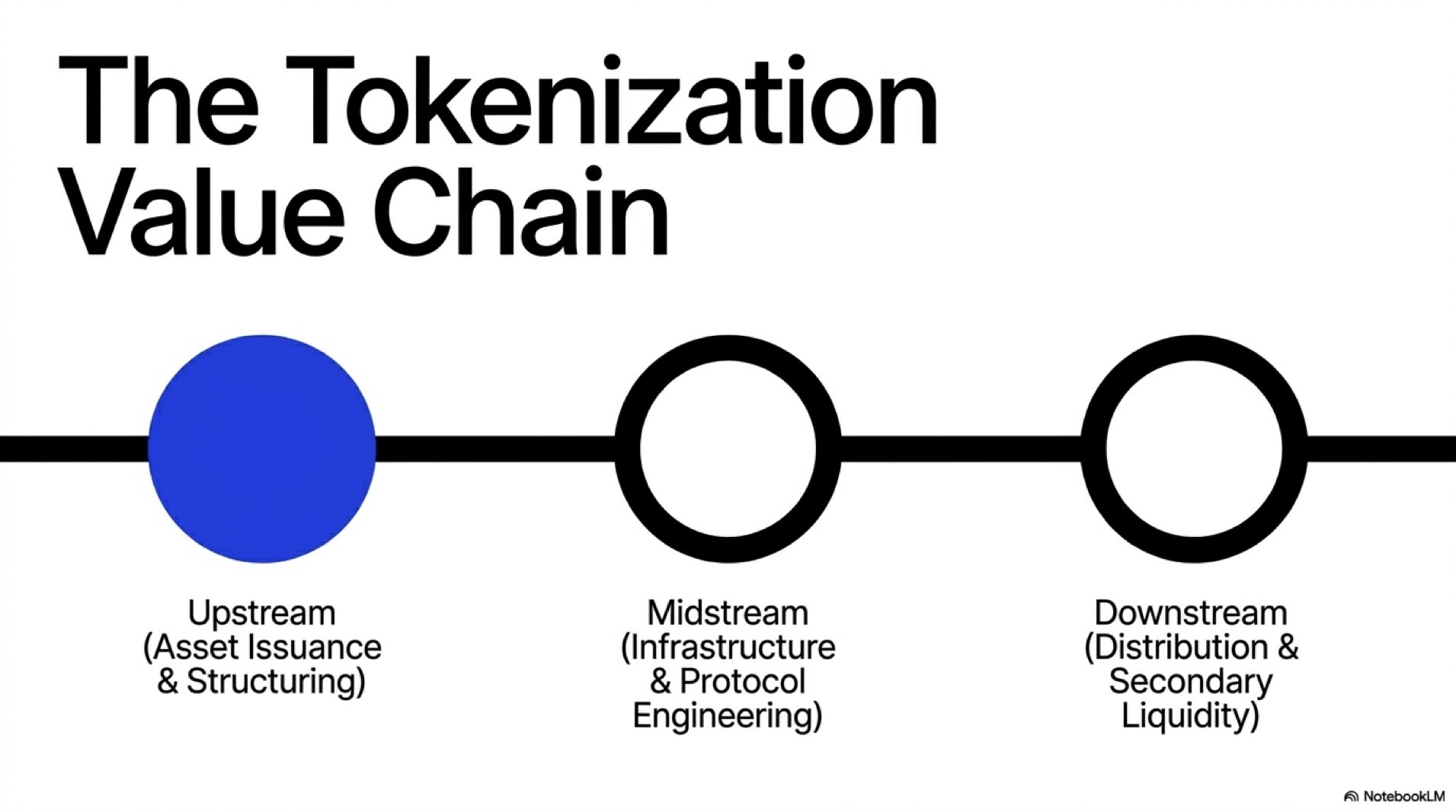
The migration of physical and traditional financial assets onto blockchain ledgers requires a highly specialized, three-tier value chain.
Upstream: Asset Issuance and Structuring
The primary bottleneck in alternative investments has always been liquidity. The upstream segment focuses on the fractionalization of illiquid assets, breaking down massive private equity funds or commercial properties into tradable, bite-sized tokens via Special Purpose Vehicles (SPVs). To ensure the integrity of tokenized real-world assets, specialized compliance oracles serve as the critical bridge. These protocols guarantee a strict 1:1 peg between the physical, legal ownership of the asset and its on-chain representation, utilizing Proof of Reserves (PoR) to feed real-time audit data directly onto the ledger.
Midstream: Infrastructure and Protocol Engineering
Institutions cannot operate in completely permissionless environments due to strict regulatory frameworks. Consequently, the midstream ecosystem is dominated by permissioned public blockchain environments. These networks leverage the security of public chains while deploying executing frameworks, such as the ERC-3643 token standard, embedded with strict Know Your Customer (KYC) and Anti-Money Laundering (AML) modules. Every smart contract acts as an automated compliance officer, ensuring that RWA tokenization fully aligns with global securities laws.
Downstream: Distribution and Secondary Market Liquidity
The ultimate value proposition of tokenization is the creation of secondary market liquidity for previously locked assets. Downstream operations have seen the launch of specialized institutional Alternative Trading Systems (ATS) and regulated liquidity pools. These platforms utilize blockchain clearing mechanisms to execute trades in real-time, achieving atomic settlement (T+0). This absolute finality eliminates counterparty risk and drastically reduces the massive capital reserves historically required for prolonged settlement cycles.
Macro Insight: Capturing the Toll-Road Value
The institutional adoption of RWA tokenization represents a complete redesign of traditional financial system architecture, not merely a new cryptocurrency narrative. The ultimate value capture within this ecosystem will not accrue primarily to the asset managers issuing the funds. Instead, the highest profit margins will be extracted by the infrastructure providers. Global digital asset custodians and cross-chain interoperability protocols, such as Chainlink CCIP, functioning as the secure bridges between traditional finance and decentralized networks, will operate as digital toll roads. These entities are uniquely positioned to capture persistent, volume-based fee revenues across the expanding multi-billion dollar tokenized economy.
Disclaimer: This content is for informational and reference purposes only. Always conduct independent research before making financial decisions.