The Great Unwinding | BOJ Rate Hikes and the Systemic Risk of Yen Carry Trade Reversals
The Bank of Japan's definitive monetary tightening trajectory in 2026 threatens to trigger a massive yen carry trade unwinding, destabilizing over $2 trillion in global assets and accelerating liquidity crunches across international bond markets.
7
min read
7
min read
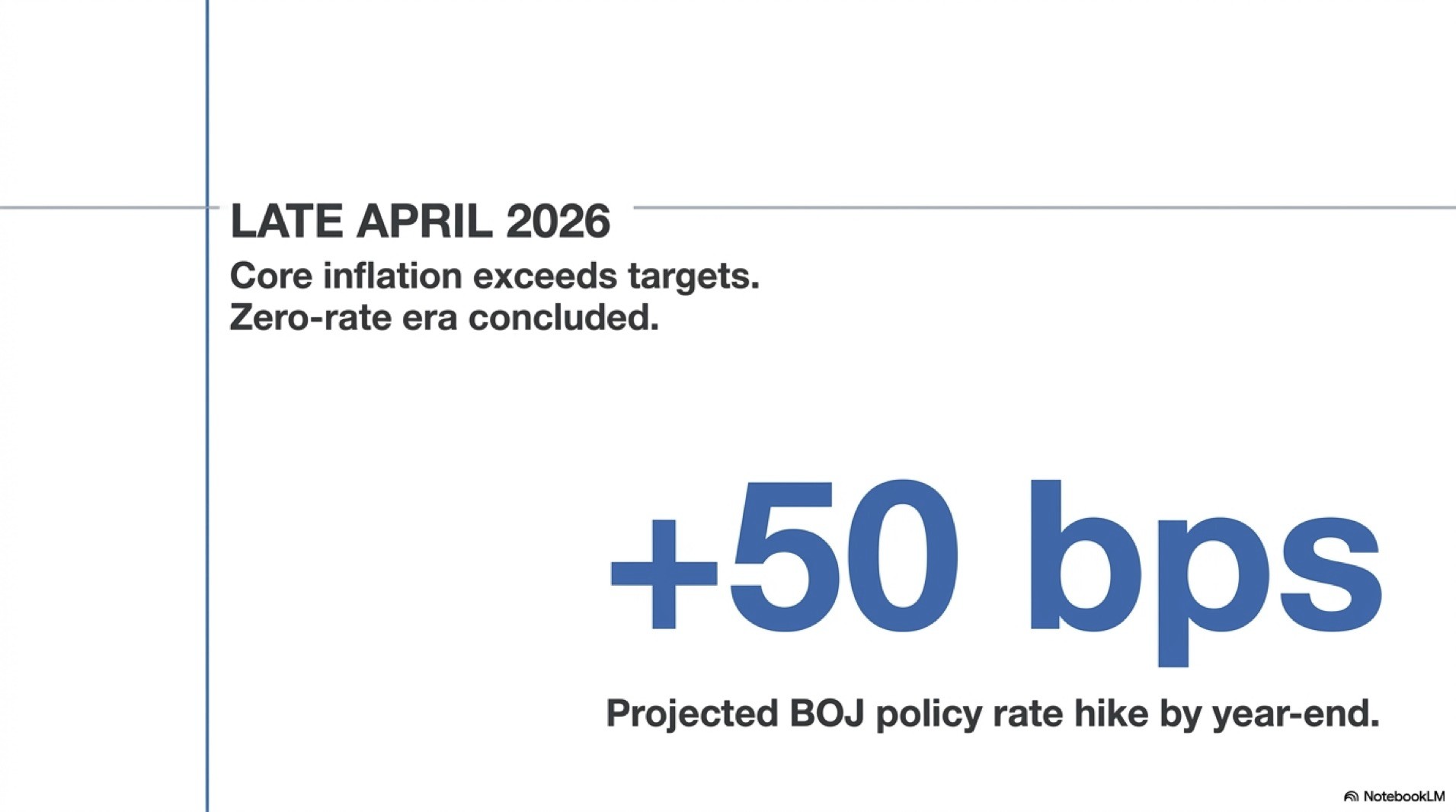
The decades-long era of ultra-loose Japanese monetary policy has officially concluded. As of late April 2026, core inflation in Japan consistently exceeds central bank targets, prompting a decisive shift in macroeconomic strategy. Global investment banks now project the Bank of Japan (BOJ) will raise its policy rate by at least an additional 50 basis points before the end of the year. This aggressive monetary trajectory fundamentally alters the global financial architecture by threatening the foundation of the yen carry trade.
For years, institutional investors borrowed cheap yen to fund positions in higher-yielding global assets, including US Treasuries and mega-cap technology equities. With an estimated $2 trillion to $3.5 trillion currently exposed according to broad institutional estimates, the forced liquidation of these positions acts as a primary catalyst for global liquidity tightening.
Understanding the Mechanics of the Carry Trade
To grasp the systemic risk posed by the BOJ policy shift, it is essential to understand how a carry trade generates returns and where the vulnerabilities lie. Investors leverage the interest rate differential between two economies. When the BOJ maintained near-zero or negative rates, the borrowing cost remained negligible. However, as the central bank withdraws quantitative easing and pushes the 10-year Japanese Government Bond (JGB) yield toward the 2.0% threshold, the fundamental mathematics of the trade collapse, forcing rapid institutional deleveraging.
Quantifying the Capital Shift
The reversal of capital flows is already materializing across major institutional data points. The compression of the US-Japan interest rate spread toward historical averages has eroded the primary incentive for offshore yen borrowing.
Macro Indicator
Q2 2026 Market Reality
Capital Repatriation
Bank for International Settlements (BIS) data indicates a severe, multi-day contraction in Japanese overseas portfolio investments and foreign-held yen loans.
FX Volatility
Implied volatility for the USD/JPY pair has breached its highest levels since the initial 2024 rate shock.
Corporate FCF
Export-driven Japanese multinationals, such as Toyota Motor Corporation, face downward revisions in Free Cash Flow (FCF) projections due to a stronger domestic currency.
Cross-Asset Repercussions and Systemic Strain
The mechanics of yen carry trade unwinding dictate that capital must flee high-risk, high-yield environments to repay appreciating yen debts. This rapid repatriation drains capital from emerging market (EM) assets and high-yield corporate bond sectors, resulting in acute global liquidity tightening.
The US sovereign debt market is highly vulnerable to this transition. As Japanese institutional investors scale back their historical purchasing volume of US Treasuries, the term premium on long-duration bonds faces upward pressure, driving bond prices down and yields up.
Conversely, the domestic Japanese financial sector is experiencing a structural renaissance. Local financial holding companies and life insurance providers, notably Mitsubishi UFJ Financial Group (MUFG), are recording significant Net Interest Margin (NIM) expansion. The ability to reinvest domestic deposits at higher yields has triggered a massive valuation rerating for Japanese banking equities.
The Imperative for Defensive Structuring
Corporate treasuries and private equity (PE) firms carrying significant cross-border exposure are aggressively securing currency hedging strategies. The demand for currency swaps and forward contracts has surged as multinational entities attempt to lock in exchange rates and defend against massive foreign exchange translation losses.
The normalization of Japanese interest rates represents a fundamental contraction of the global liquidity supply chain. From an asset allocation perspective, maintaining unhedged global equity exposure carries asymmetrical downside risk. Navigating this macro cycle requires a strategic reallocation of capital, prioritizing Japanese domestic financial equities that directly benefit from rate hikes alongside heavily hedged infrastructure assets capable of withstanding severe currency volatility.
Disclaimer: This content is for informational and reference purposes only. Always conduct independent research before making financial decisions.